




Typical Specification Range
| Parameter | Typical Range |
|---|---|
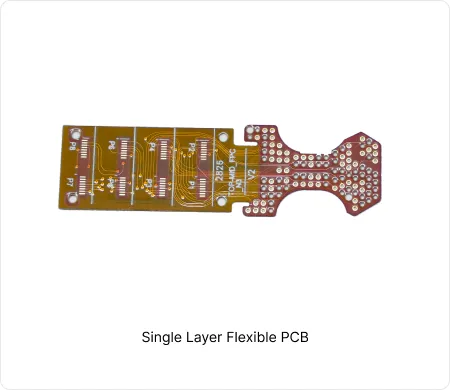
| Layer count | 1 |
| Material type | Polyimide film, PET film |
| Surface finish | ENIG, OSP, Immersion tin |
| Thickness | 0.1mm – 0.32mm |
| Solder mask | Yellow, white, black |
| Copper thickness | 0.5oz to 1oz |
| Special features | Dynamic flex capability, stiffener attachment, tight bend radius |
Manufacturing Process Insights
Lamination bonds copper foil to dielectric film under controlled heat and tension.
Patterning applies photoresist, exposes, develops, then etches copper traces.
Drilling or punching creates component holes with precise registration.
Plating deposits metal in holes when electrical continuity is required.
Surface finish is applied according to assembly method and storage duration.
Risk control centers on material shrinkage management and registration accuracy throughout all thermal steps.
Manufacturing Order Profile
| Order Quantity | Order Proportion | Estimated Price Level | Typical Lead Time |
|---|---|---|---|
| Prototype (<=30 pcs) | 54% | From $43 | From 4 days |
| Small volume (30-200 pcs) | 34% | From $70 | From 4 days |
| Mass production (>200 pcs) | 12% | From $139 | From 5 days |
Manufacturing Challenges & Process Optimization
Material Shrinkage During Processing
Single layer flex films exhibit dimensional change when exposed to repeated thermal cycles.
High CTE of polyimide and built-in copper stress create unpredictable movement across panels.
Dimensional variation causes registration errors that reduce yield and prevent consistent final form factor.
Apply stabilized pre-baking and tension control prior to lamination.
Use vacuum fixtures and laser fiducial systems to maintain alignment during pressing.
Conduct automated optical inspection after each critical thermal process step.
Design Considerations
Single layer stackups define copper position relative to bend axis. Coverlay thickness and adhesive flow must be considered. Stiffener locations require careful planning for mechanical support.
Vias are minimized on single layer flex to preserve flexibility. When required, larger hole diameters improve plating reliability. Plated holes increase cracking risk during repeated bending.
Polyimide provides higher temperature rating than PET. Adhesiveless constructions offer better dimensional stability. Material choice balances flexibility, cost, and environmental resistance.
ENIG suits most soldering applications on flex circuits. OSP reduces cost but limits shelf life. Finish selection must match assembly process and operating environment.