




Typical Specification Range
| Parameter | Typical Range |
|---|---|
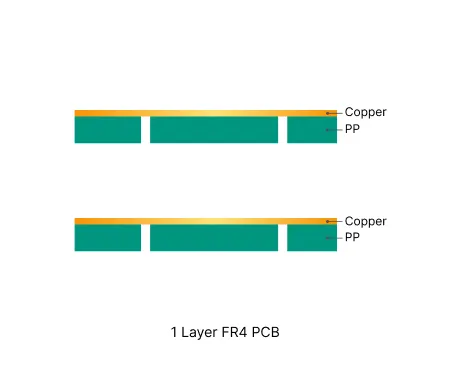
| Layer count | 1 |
| Material type | FR4 TG130 to TG150 |
| Surface finish | HASL, OSP, ENIG |
| Thickness | 0.8mm – 2.0mm |
| Solder mask | Green, black, red, white, yellow, blue, purple, matte black |
| Copper thickness | 1oz – 3oz |
| Special features | Carbon ink, bare board, silver paste |
Manufacturing Process Insights
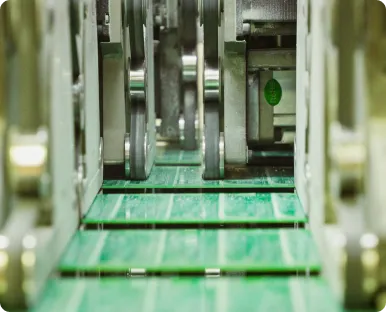
1-layer FR4 PCBs begin with copper-clad laminate. Mechanical drilling creates all required holes before electroless plating. Core Steps Pattern imaging followed by copper etching defines circuit traces. Solder mask application and surface finish complete the base process. Surface finish selection balances solderability, cost, and shelf life. Key risk control centers on etch uniformity and precise solder mask registration to maintain yield.
Manufacturing Order Profile
| Order Quantity | Order Proportion | Estimated Price Level | Typical Lead Time |
|---|---|---|---|
| Prototype (<=30 pcs) | 29% | From $1 | From 1 Day |
| Small volume (30-200 pcs) | 42% | From $20 | From 1 Day |
| Mass production (>200 pcs) | 29% | From $40 | From 1 Day |
Manufacturing Challenges & Process Optimization
Etching Uniformity
Single layer boards frequently require consistent trace widths especially near fine pitch components. Variations in etchant concentration, temperature, and spray pressure across large panels create differential etch rates.
Resulting trace width deviation increases resistance in power circuits and risks shorts in dense layouts. This directly reduces both production yield and field reliability.
Deploy real-time etchant monitoring systems with frequent chemical analysis.
Apply etch factor compensation in design rules and maintain strict spray pressure calibration.
Perform automated optical inspection immediately after etching on every panel.
Design Considerations
Single layer boards require no multilayer planning. Uniform copper distribution across the panel helps control thermal warpage during processing and assembly.
Only plated through holes are possible. Minimize hole quantity to control drilling cost. Component leads frequently provide necessary electrical connections.
Standard FR4 suits most applications. Higher Tg variants improve thermal stability during lead-free soldering. Material selection must match operating environment requirements.
HASL offers low cost with good solderability. OSP provides flat surfaces for SMT. ENIG delivers superior oxidation resistance but raises cost for basic single layer designs.