




Typical Specification Range
| Parameter | Typical Range |
|---|---|
| Layer count | 4 layers |
| Material type | FR-4, High Tg FR-4 |
| Surface finish | ENIG, OSP, Immersion Tin |
| Thickness | 0.4mm to 3.2mm |
| Solder mask | Green, black, red, white, yellow, blue, purple |
| Copper thickness | 0.5oz to 2oz |
| Special features | Blind microvias, stacked vias, fine pitch lines |
Manufacturing Process Insights
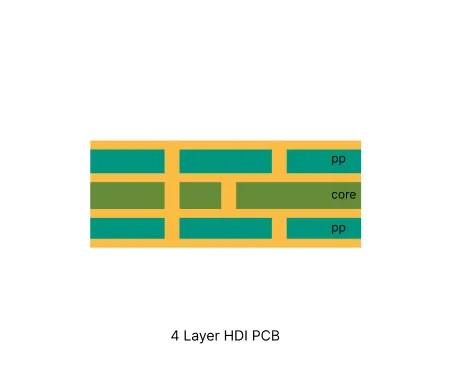
Sequential Lamination: Inner core is laminated first. Outer layers add through controlled press cycles with prepreg.
Laser Drilling: UV and CO2 lasers create microvias. Plasma desmear follows to clean via walls.
Plating Logic: Direct metallization and electrolytic copper fill microvias uniformly. Current density is tightly controlled.
Surface Finish: ENIG is preferred for fine pitch assembly reliability.
Registration control and via inspection mitigate risks throughout the process.
Manufacturing Order Profile
| Order Quantity | Order Proportion | Estimated Price Level | Typical Lead Time |
|---|---|---|---|
| Prototype (<=30 pcs) | 69% | From $180 | From 7 days |
| Small volume (30-200 pcs) | 22% | From $220 | From 8 days |
| Mass production (>200 pcs) | 9% | From $330 | From 8 days |
Manufacturing Challenges & Process Optimization
Microvia Plating Voids
4 layer HDI boards often show plating voids in laser drilled microvias during volume runs.
Laser residue and high aspect ratios limit copper throw in electrolytic plating.
Voids create high resistance paths that fail under thermal cycling. This lowers first pass yield and long-term reliability.
Optimize laser parameters and desmear process.
Combine plasma and chemical desmear. Maintain strict plating bath control.
Use cross-section analysis on production coupons.
Design Considerations
Arrange layers to support required impedance. Balance dielectric thickness for microvia reliability. This approach maintains both electrical performance and manufacturability.
Use blind microvias for outer layer interconnects. Limit stacking depth to two. This choice improves plating yield while maximizing routing density.
Select FR-4 with appropriate Tg for operating conditions. Verify resin flow supports laser drilling. Material choice directly affects via quality and thermal reliability.
ENIG offers flat surface for fine pitch assembly. Control nickel thickness to avoid black pad. This finish supports both soldering and long-term contact reliability.